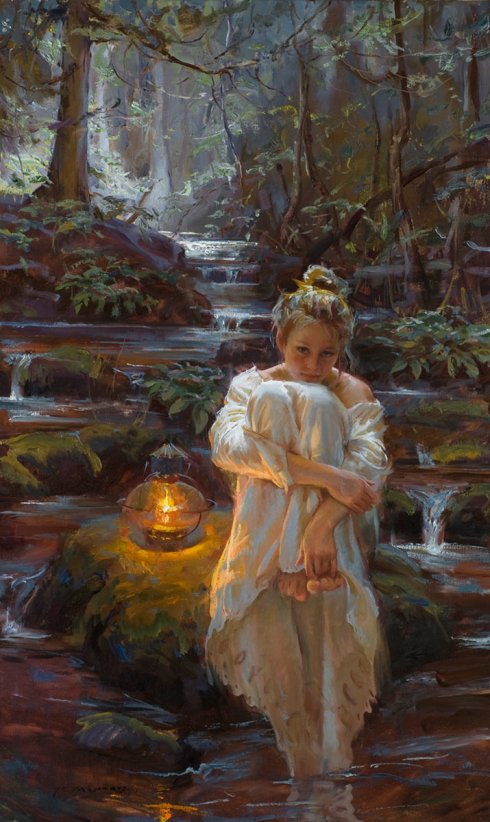
Glow

On a winter evening a few years ago, Jennifer and I attended a party recognizing and celebrating the album release of a friend’s music. The event was beautifully staged and in contrast to the cold, dark night, the warm candlelit environment they created was breathtaking and somewhat otherworldly. As an artist, my only regret from the evening was that I couldn’t capture the effect on canvas. From a practicality stand point, I knew I couldn’t ask the hosts to leave their house in disarray for weeks so that I could paint from life, so not to be deterred and let the inspiration slip away, I arranged to recreate the mood in the studio. During the following week, our friends who served the party agreed to model, the food and candles were gathered, and the work began. Among the most challenging aspects in capturing this festive gathering in paint were:
- Not burning the studio down.
- Establishing the lightest lights and holding the key, specifically not allowing any of the lights in her white apron to supersede the candle’s glow.
- Getting enough light on my canvas to see while the models remained in the darker candlelit space.
- Achieving a balance of color temperature throughout the canvas. In an overwhelmingly warm light source such as candle glow, the tendency is to only paint the obvious warmth of the light. I was again reminded that it is the introduction of the complement that accentuates the warmth and strengthens the forms. Remember to look for the complete balance in all areas! In this case, it meant finding the cool tones in the models skin and clothes, the candles, the tablecloth, the artichokes, etc., etc….
- Arranging the candles in an interesting line to create negative spaces between them that were as interesting as the candles themselves.
- Creating variety in the candle flames so as not to be to repetitive in the shape, value and color.
- Coming up with enough jokes to keep the models smiling for days on end.
- Not burning the studio down.

Enjoy!!!

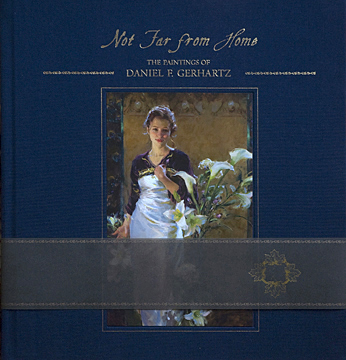
Thanks for considering “Not Far from Home”…
Like this:
Be the first to like this post.
1 comment | posted in Uncategorized
Should I, Shouldn’t I…
I remember the day like it was yesterday. The notion of standing in a snow bank for several hours on this cold, dark, damp winter afternoon surely didn’t sound appealing and the temptation to return home to the fireplace and some tea was calling loudly. The yawns were growing closer and closer as I meandered down the back roads of home and all I could hear in my head was the recording “Should I just call it quits for the day?”, “Do I allow the self-rationalizing to reign and talk myself into how I couldn’t possibly be lazy by succumbing to comfort rather than work?” I am glad that on this occasion I did not.

Farm on Beaver Dam Road 18 x 30 (page 92 and 93 with detail in “Not Far from Home”)
The awakening began as I opened the car door and saw the colors true, not through the subtle green tint of the windshield. The colors, though in great reserve, still called out before me…the warm greens of the shadows in the snow gave way to a violet cast as the brightness of the foreground bled toward me. The shift from red to green on the face of the barn boards was exquisite. The humidity accentuated the variety in edges as the snow covered roofs stood in stark to the wisps of branches in front of them. All of this I would have missed had I stayed in the car.
What is my point in all of this? Every day, every condition, has something to offer despite my feelings. What a gift.
Some twenty-five years ago as I was about to embark into this world of painting, a dear friend and co-worker of mine from the illustration days, Kenn Backhaus, gifted me with a little gold plaque that was mounted on my French easel for years. It now proudly hangs in my studio. The quote inscribed was by the great American Impressionist, Walter Elmer Schofield, “Rain, falling snow, wind…All these things to contend with, only make the open air painter love the fight.” (I might add bugs, too!)

“Not Far from Home” Testimonial from Glenn Terry
“Got Daniel Gerhartz ‘s book of paintings, “Not Far From Home” yesterday. It is a fantastic book, full of tremendous beauty in the paintings, close up details, and even a step by step process in the back. The book itself is well made, worth the cost and then some, and can’t help but to inspire artists at any level, seeing the works of a master painter with such a fresh and vigorous style, full of heart and love of life.”
Thanks for all of your encouragement folks!
Like this:
Be the first to like this post.
Leave a comment | tags: don't be lazy, winter colors, winter landscapes | posted in Impressionistic Painter, painting snow, Simple life, Technical Insights in Painting, Uncategorized, Winter landscapes
Warm, Cool, Warm…

One of the key elements that I have taken away from years of painting from life is the heightened awareness of the warm /cool interplay on the subject as the form turns. I know I have mentioned this on previous posts, but its importance bears mentioning again. In this image and the details to follow, you will see how the shifting of temperature accentuates the volume and three dimensionality of image while holding the values in a simple mass. It can also be seen in great detail within the two page spread of, “Indigo and Ivory”, 30” x 60” (Page 118 and 119 from “Not Far from Home”),


In these details, you can see the transitions from warm to cool inter-playing throughout the forms, but most specifically where noted with letters W (warm) C(cool). See how close in value these tones are, yet there is still a noticeable form change. My first discovery of this application came to me years ago when studying a Sargent painting at the Museum of Fine Arts in Boston. In his painting, “The Daughters of Edward Darley Boit”, Mr. Sargent rimmed the outside edge of the light plane on the foreground girl’s blouse with a cool tone to give the added feeling of cool light and also to aid in the turning of the form. This accentuated coolness along the rim of all of all forms can also be seen in William Bouguereau’s works. The pictured Dennis Miller Bunker portrait has also been a favorite of mine and illustrates this point nicely. I would urge you to see their works first hand to study just how effective and evident this application is.

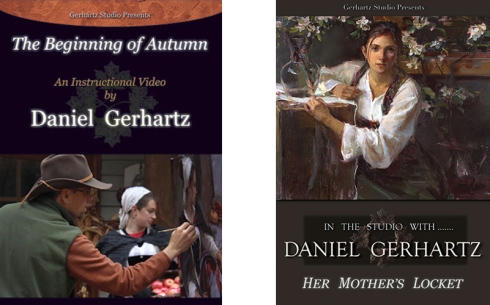
This study of warm and cool as it relates to light and form is discussed and demonstrated in great detail in our re-released Video “Her Mother’s Locket”. The new On Demand streaming format released at a significantly lower price will enable you to watch this instruction from any computer or iPad with internet capability. In the new version, we have also added hi-res photos to see the completed painting as it is being painted before you. You will see the 30 x 36 studio painting from start to finish with moment by moment commentary, sharing with the viewer the critical elements of building the design and execution of this work.

To purchase “Her Mother’s Locket” instruction, please click painting.
Click image to see preview trailer…Thanks

Enjoy!
Like this:
Be the first to like this post.
2 comments | tags: color temperature, reclining figure, red heads | posted in Elegant paintings, Important Art collections, Uncategorized
Vibrant

As I began to decide on the composition for this work, the question arose in my mind, (as it always does when staring at a white canvas), “How can I make this work unique”, or, “How can this portrait, not appear as just another stale, predictable depiction of a pretty girl.” Many different elements may have been used with to achieve this end, whether it is limiting the palette of colors, pushing the key or value range into something far more moody, the unusual cropping of the figure, or other various methods.

In this case as I was moving the lighting around the model trying to reposition things to get a fresh look, I noticed the striking abstract created by the models face against the lighter background. This technique is certainly not original with me, as I have seen the great illustrators of the past employ this effect beautifully. The works of Frank Brangwyn and Dean Cornwell stand out in particular. Notice how the figure or heads are not immediately visible but rather are part of the greater compositional whole.

Dean Cornwell

Frank Brangwyn
The lights and darks follow the pre-established patterning and flow of connected values. The strong abstract pattern was most important to them. This, too, should be just as important to us. My take away from these masters has been to try to see the subject in the abstract more than just a literal portrait on canvas. My former teacher Bill Parks would fill dozens of sketchbooks with 2” x 3” designs just to explore the infinite variety within shape and size juxtaposition. He often mentioned that the painting should just as interesting at 50 yards away as it is upon close inspection. His voice is still ringing in my head… how grateful I am for his tutelage. I must mention that in addition to Bill’s voice, Jennifer’s parting words as I am heading for the studio are often, “Design, Design, Design”… for her reminders I am grateful as well.
Click Book for more details…Thank you!
Like this:
Be the first to like this post.
1 comment | tags: Cabernet, figure and still life, painting hair, painting hands, painting pearls, painting red roses, Painting Roses, painting still lifes, pearls, red roses | posted in beautiful women, elegant portraits, Not Far from Home, Painting edges, Painting People, Painting Tips, Painting women, portrait painter, portrait painting, Uncategorized
The Passage
As a visual artist, I am continually challenged with the idea of what I am to say with the language and medium I have been given. Most often in my case, the simple and profound message of hope as it points to our Creator through “the beautiful” is more than sufficient and provides all I that I wish to say with most subjects. In other words, the fact that I am struck by the simple elegance of a line in nature, or the moving harmony of two or more colors dancing together are more than enough reasons to record them and provide ample material for a work of great meaning. However, there have been instances when I have been inspired to include an overarching narrative to depict an emotion or tell a story. This painting “The Passage”, page 123, was one of those for me.

The inspiration for this work came in a vision of the completed painting that flashed in my mind as I lay in bed ready to retire for the day. Just weeks earlier, during a time of great sadness, I had the privilege of being with my father as he breathed his last breath and lost the battle from a relatively short illness. This moment of profound loss was also one of the more sacred times in my life. As I witnessed his passing, I could not help but wonder how we are transported to the next realm and what his journey may have looked like. I, in no way mean to conclude that this image has any historical accuracy, is substantiated by scripture, or is what our experience will look like. I was simply following the inspiration and seeing it through. What I am certain of is the great hope of eternal life we have through our Lord and I stand on that as I move ahead.

These following passages have always given me great comfort and offer such assurance.
Jesus said to her, “I am the resurrection and the life. The one who believes in me will live, even though they die; and whoever lives by believing in me will never die. Do you believe this?”
John 11:25
I know that my redeemer lives,
and that in the end he will stand on the earth.
And after my skin has been destroyed,
yet in my flesh I will see God;
I myself will see him
with my own eyes—I, and not another.
Job 19:25

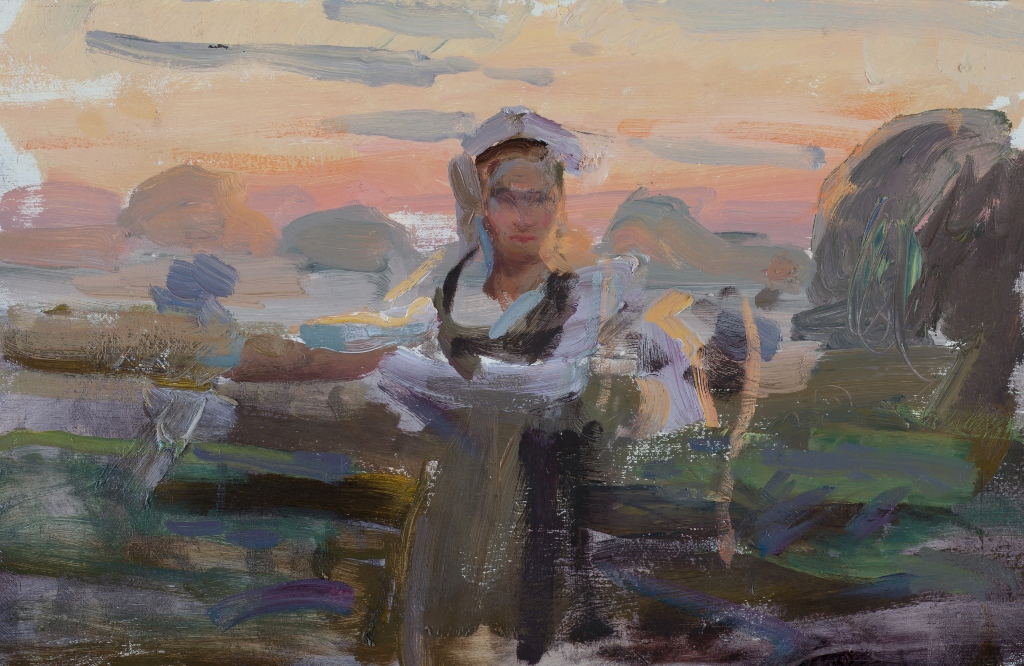
As to the execution of this work, various studies were completed on location of the model in twilight light on the shores of a river. As you can see in the study, not much attention was paid to detail or proper drawing as the light was fleeting fast. In this case, it was only important to capture accurate values and color relationships to translate the effect of light in the finished piece. Later in the studio, I then transposed the key to create the desired lighting to better depict the mood. Finally, a sketch was created one quarter size to work out the harmonies and final design before the finished canvas was begun.
Click book for more info.
Blessings…
Like this:
Be the first to like this post.
5 comments | tags: glowing light, great hope, hopeful thoughts, near death experiences, paintings about hope, riverdance, seeing the light | posted in American Artist, beautiful women, glowing light, Near death experiences, painting beautiful women, Seeing the light
Keeping it Fresh
Keeping it Fresh
While I have primarily been an oil painter for the last 25 years, I find it important from time to time to change mediums just to keep my thinking and approach fresh. The following two works (pages 50 and51) from “Not Far from Home”, are examples of such attempts. “A True Gentleman” is a pastel painted on Wallis sanded paper and the watercolor, “Bohemian”, was painted on 300lb rough Arches Watercolor paper. While the lighting was similar on both, warm rim light, the application of paint was reverse in the watercolor as I needed to preserve the white of the paper for the lights as opposed to opaquely added the lights on top of the darks in the pastel.

Other means can also be employed to keep your approach honest, one effective path is to shake up the lighting of the subject. I encourage my students to paint many different types of light effects so as not to become too familiar and formulaic in their seeing and color mixing. This forces us to really look at the relationships and harmonies to accurately relay the effect of light. (I should add here that while the subject is lit with differing temperatures, I find it crucial to have balanced light on my canvas and if possible the palette). As I begin a new work, I will often paint a different temperature or angle of light from the last effort to maintain honesty is seeing. Warm light, cool light, front light, back light, Twilight and nocturnes all offer nice alternatives and will keep you scratching your head!

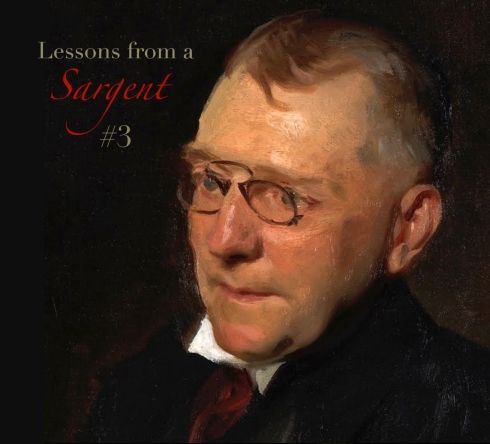
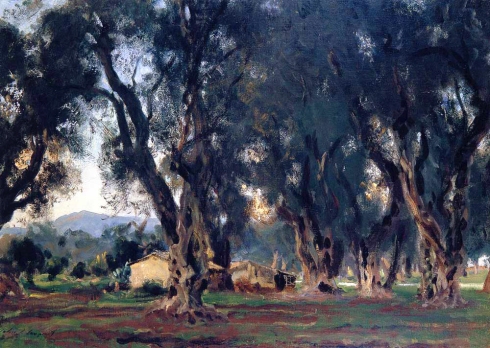
Anders Zorn and John Singer Sargent’s works are truly an inspiration as they fluidly switched between the mediums of oil and watercolor to capture what they saw beautiful. I encourage you to look them up as well!

Thanks much!
Like this:
Be the first to like this post.
1 comment | tags: bohemian men, bohemian paintings, painting light, pastel portraits, watercolor portraits | posted in creating dimension, portrait painter, Uncategorized
Resolutions
As I am anxious to start the new year with it’s hopes, dreams and new beginnings, I am reminded of how on a smaller scale to the artist, a fresh white canvas offers hopes and dreams all on its own. Just as in life we see the importance of looking back in review to more effectively move ahead, I am reminded of the necessity to treat each new canvas with the same degree of serious reflection so as to learn from the last attempt.
Each painting must begin with a resolution of sorts, to improve upon a deficiency in edges, value, drawing, or color to greater achieve the mood you are aiming for. I am continually striving to get to the next level and have found that it clearly helps to have a plan formed before the brush hits the canvas. Be specific. Resist thinking, “I hope this one turns out better”, but rather meditate on, “What specifically do I need to work on to gain greater sensitivity or strength in my work”. If you have trouble identifying what that might be on your own, ask someone you trust to tell you the truth. I am extremely dependent on “outside” help. My wife Jennifer has an amazing eye and often sees what I miss.

I remember specifically the resolution I made prior to this painting, “Tricia”, page 33, that being to severely limit my color palette.
My work had become too colorful, meaning I was using color for color’s sake, throwing it in haphazardly and not being truthful with what I was seeing. The “circus” look was not working!!! Having recently viewed an Anders Zorn exhibition helped me to identify this color problem and I recognized that something had to change. As an exercise, this work was completed using his choice of colors as well, that of, white, black, raw sienna, and Rembrandt’s Permanent Red Medium, (which closely resembles the vermillion Zorn used. I have since broadened my palette again, but the lesson was invaluable to teach me what effects could be achieved with very little shift in color.
I wish you great paintings as you break out into the New Year!

Thank you for your enthusiastic support of Not Far from Home!
Like this:
One blogger likes this post.
3 comments | tags: american portrait painter, hopes and dreams, limited palette, new year's resolution, painting portraits, portraits, resolutions, white canvas, zorn's palette | posted in Daniel Gerhartz, New Year's resolutions, Painting from Life, Painting People, portrait painter, portrait painting, Uncategorized
At the young age of 16, Carl Marr left his home and family in Milwaukee, Wisconsin, to study art abroad in Munich, Germany. The story goes that this homesick lad had shared his feelings of sadness with his maid when he left go visit friends for a Christmas eve gathering. Upon his return, Carl had been beautifully moved by the kind gesture of his maid friend who had set up this tree in hopes to lift the boy’s spirits. In fact he was so inspired, he set up his easel and recorded the scene for generations to enjoy. This work of Carl’s has always been one that I have been taken by and when visiting the museum, I make it a point to soak in its ambiance.
Apart from its general beauty, I have noticed several technical things that may be of interest…. Notice that every square inch of the canvas has an influence of red and green in it to balance the harmony. As he did this from life, it makes seeing all of the color and attaining that harmony much easier. In terms of value, notice how much darker the tablecloth is compared to the candle flames. This is necessary in order for the light effect to read. In terms of edge, I have taken note of how Carl has softened the “architecture” of the furniture so as to keep the interest on the focal point.


Lastly, included below is a work that I completed that features a stable or creche that my great-grandfather built for his family many, many years ago. Enjoy… and Merry Christmas!

Click book for more info…thank you!
Like this:
Be the first to like this post.
2 comments | tags: Carl Marr, Carl von Marr, christmas paintings, creche, old fashioned christmas | posted in Carl Marr, Christmas paintings, Color Studies in Painting, Copying the Masters, Daniel Gerhartz, Impressionistic Painter, Inspiration, Oil Painting, Uncategorized
“Bring on the Wonder,”
Over the years many have asked, “Where do you get all of your ideas for paintings”, or, “Is it hard to constantly come up with fresh concepts”. I have found that if I simply live and soak in the world around me, there is ample visual stimulus to spark what I need for a composition. The problem more often is how to distill all of the input into something I can wrap my mind around to utilize.

One example of how a painting began with the simplest of inspiration is found in the work, “A Light in the Darkness”, page 156 in “Not Far from Home”.

As I was walking to the studio one day, the branch of a cottonwood tree had fallen on the path that I trod. As anybody would, I picked it up to toss it aside but then noticed the amazing harmony of the muted violets and ochres interplaying on the leaves. This stopped me long enough to further observe the spellbinding rhythm of line created by the leaf stems that wove my eye in and around the branch. It was then that my mind made the connection that this may be useful in a painting or may serve as a foil to set a model against. So instead of tossing it aside, it made its way to the model stand and I began to assemble the composition around this element.
It was important to build the design with elements that worked with and not against the aspects of the original inspiration. For instance, it was the subtle dance of color between violet and yellow that first caught my eye, so why would I add all kinds of other color influences that would dilute or distract from this subtle harmony. In terms of rhythm of line, it was important to choose lines that echoed the branch and did not fight against the swing of line.
Having mentioned how this work came about with some ease and seeming happenstance, I am fully aware of how it is not always easy to see the world with the wonder of a child to pick up on the nuances of line, harmony, design, etc… For a period of time after my father passed away, I was numbed to the beauty and couldn’t find joy in the simplest of things. Thankfully prayer and time has brought back that sense wonder. I found that asking God to open my eyes anew helped to see again as a child. I do not share this to be sanctimonious, but simply to tell my story and share the struggle. The lyrics of Sarah McLachlan’s “Bring on the Wonder” so poignantly illustrate my heart’s cry during this time. “Bring on the wonder, bring on the song, I pushed you down deep in my soul for too long…” How refreshing to break through.
I wish you great joy as you find the inspiration that will lead to your next great work!

Click Book for more info…thank you!
Like this:
Be the first to like this post.
3 comments | tags: bring on the wonder, candle light, cottonwood, inspired poetry, light darkness, painting candlelight, sarah mclachlan | posted in creative paintings, Daniel Gerhartz, ideas for paintings, Impressionistic Painter, nocturnes, Painting nocturnes, Uncategorized
Discouragement and “Forgiven”
Have you ever had a day when you were not sure that what you were doing had any meaning? Or had the feeling that in light of all the world events, this practice of moving colored mud around a canvas may be overwhelmingly trivial.

I was having “one of those days” when I began this work, “Forgiven”. I am grateful to have been given the energy to push through the discouragement of the moment, because as I began the preliminary drawing on the canvas and the charcoal followed the line of her skull, I was immediately exhilarated with a sense that I was exactly where I needed to be, doing precisely what I had been made for. The simple act of mimicking the rhythmic and mathematical line of this Egyptian woman’s head created such a sensation…amazing. I truly believe our Creator had this reaction in mind when our world was knit together. (Not just for me specifically or for artists in general, but for all who respond to His calling, whatever it may be). For me, this changes everything.
For me it means that investing my time to study beauty and recording it for others to see in a fresh way has tremendous meaning. This may be an obvious no-brainer to most, but for some reason I need to be reminded of this from time to time.
Discouragement can be a wicked taskmaster, but I find that if when facing it, I simply put myself in the position to be inspired, it will surely dissipate. And what exactly do I mean by “putting myself in the position to be inspired”. For me, it is simply hiring a model and watching the beauty unfold as the light falls upon it. Unfortunately, left to my own devices, this does not always happen on its own as it seems at times I would rather mope than be fruitful. Fortunately, my wife Jennifer then gently reminds me to hire a model and allow myself to be moved… (thanks Jen).
On this week of Thanksgiving in America, among many other things, I am grateful to our Maker for the inspirations I have received and for His endless mercy and undeserved grace as I stumble my way through this life.
Happy Thanksgiving!

Click Book for more info…thank you!
Like this:
Be the first to like this post.
4 comments | tags: anointing, at the feet of Jesus, broken, forgiven, forgiveness, mary magdalene, mercy, mercy granted, mercy painted, paintings of grace, worship | posted in Uncategorized